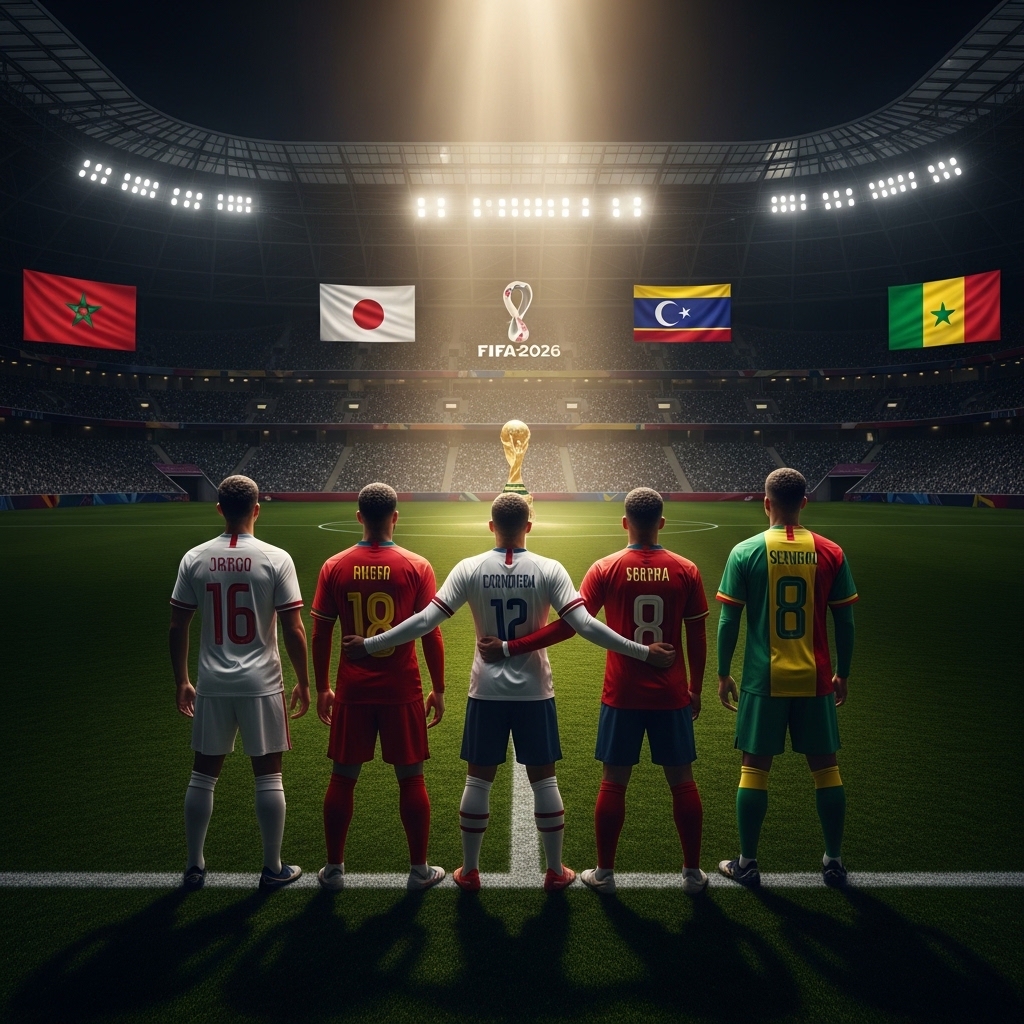
The FIFA World Cup 2026 is not just the next instalment of football's greatest tournament. It is the largest, most ambitious, and most structurally different World Cup in the competition's 96-year history. For the first time ever, 48 national teams will compete across three host nations — the United States, Canada, and Mexico — in 16 cities, 16 stadiums, over the course of five weeks that will generate more football, more viewers, more commercial activity, and more cultural weight than any sporting event ever staged.
This is your complete guide to everything about FIFA World Cup 2026. Bookmark it, share it, return to it. We'll be covering every match, every development, and every major story as the tournament unfolds — and this is the foundation you need to follow it properly.
📋 What's in This Guide
- Tournament Overview — The Key Numbers
- The New 48-Team Format Explained
- Host Cities & Stadiums — All 16 Venues
- Tournament Schedule at a Glance
- Top Contenders — Who Will Win It?
- 10 Players to Watch in 2026
- The Biggest Stories of the Tournament
- 7 Fascinating Facts About 2026
- Frequently Asked Questions
🌠Tournament Overview — The Key Numbers
The scale of 2026 is genuinely difficult to comprehend in conventional sporting terms. At 104 matches — up from 64 in Qatar — it is 62.5% larger than any previous World Cup. The prize fund has been confirmed at over $1 billion across all participants. The Host Broadcast Centre will be the largest ever constructed for a sports event. And with three host nations spanning two continents and six different time zones, no previous sporting event has had to manage the logistical complexity that FIFA and the three host Football Associations are navigating in 2026.
For fans, that scale translates to something simple and extraordinary: more football, more teams, more matches, and more stories than any World Cup that has ever been played. For neutral viewers with no single team to follow, 2026 is the richest tournament in history.
📠The New 48-Team Format Explained
The format change from 32 to 48 teams is the most significant structural shift in the World Cup since the competition expanded from 24 to 32 teams in 1998. It changes the mathematics of the tournament at every level — how teams qualify, how groups work, how far weaker nations can realistically progress, and how the knockout rounds are structured. Here is what it means in practice.
The key change beyond the expanded group stage is the addition of a Round of 32 — a new knockout round that replaces the Round of 16 as the first elimination stage. This means every team that qualifies from its group has at least one guaranteed knockout match before facing the risk of early elimination. For smaller nations, this is a significant cushion. For the major footballing nations, it means one additional fixture that could — in theory — produce a major upset.
â Why the Format Change Matters for Fans
Twelve group stage places have been added across Africa (3 extra), Asia (2 extra), CONCACAF (1.5 extra), South America (1 extra), and Europe (1 extra). This means football nations that were previously excluded — and have large, passionate supporter communities — are attending their first World Cup. More teams means more narratives, more upsets, and a genuinely more global tournament.
ðŸŸï¸ Host Cities & Stadiums — All 16 Venues
The 2026 World Cup will be played across three countries and sixteen cities — a feat of multi-nation coordination that required years of infrastructure planning across different regulatory frameworks, transport networks, and stadium specifications. The USA hosts eleven venues, Canada and Mexico host three each. The Final will be played at MetLife Stadium in East Rutherford, New Jersey — one of the largest stadiums in the Western Hemisphere.
🇺🇸 United States Host Cities
🇨🇦 Canada Host Cities
🇲🇽 Mexico Host Cities
📅 Tournament Schedule at a Glance
| Phase | Dates | Matches | Details |
|---|---|---|---|
| Group Stage | June 11 – July 2, 2026 | 72 matches | 12 groups of 4 teams, top 2 + 8 best 3rd-place teams advance |
| Round of 32 | July 4 – July 9, 2026 | 16 matches | First knockout round — new addition to the format |
| Round of 16 | July 10 – July 13, 2026 | 8 matches | 16 teams remain — tournament entering decisive phase |
| Quarter-Finals | July 17 – July 19, 2026 | 4 matches | Final 8 nations — semi-final places at stake |
| Semi-Finals | July 23 – July 24, 2026 | 2 matches | SoFi Stadium (LA) and AT&T Stadium (Dallas) |
| 🆠The Final | July 19, 2026 | 1 match | MetLife Stadium, East Rutherford, New Jersey — 5B+ viewers |
🥇 Top Contenders — Who Will Win It?
The expanded 48-team format means more teams, but the pool of realistic winners is if anything narrower than in recent tournaments — because the extra games favour teams with squad depth and tactical flexibility, which is precisely what the major European and South American nations have in abundance. Here is the HJ Trending assessment of every genuine contender for the 2026 title.
| Team | Win Probability | Tier | Key Strength | Key Risk |
|---|---|---|---|---|
| 🇫🇷 France | 22% | Favourite | Deepest squad in the tournament — elite in every position | Mbappé must deliver in crucial moments |
| 🇧🇷 Brazil | 18% | Favourite | Attacking talent unmatched — Vinicius Jr., Rodrygo, Endrick | Defensive vulnerabilities vs press-heavy teams |
| ðŸ´ó §ó ¢ó ¥ó ®ó §ó ¿ England | 14% | Contender | Golden generation finally maturing — Bellingham leads | 60 years of tournament trauma and penalty shootouts |
| 🇵🇹 Portugal | 11% | Contender | Deepest squad since 2006 — Bruno Fernandes + Leão elite | Ronaldo's ego vs team harmony in knockout rounds |
| 🇩🇪 Germany | 9% | Contender | Rebuilt under Nagelsmann — clinical and organized | No definitive striker of world-class calibre |
| 🇦🇷 Argentina | 9% | Contender | Defending champions — experience, belief, and Messi's legacy drive | Post-Messi squad depth drops sharply |
| 🇪🇸 Spain | 8% | Contender | Yamal, Pedri, Morata — the most technically gifted young squad | Can they replicate Euro 2024 form at a longer tournament? |
| 🇳🇱 Netherlands | 5% | Dark Horse | Van Dijk's leadership + attacking options wide and deep | Historically underperform in the knockout rounds |
| 🇺🇸 United States | 4% | Dark Horse | Home advantage, rising MLS talent, Pulisic leadership | Have never reached a World Cup semi-final |
| 🇲🇦 Morocco | 3% | Dark Horse | Semi-finalists in Qatar — African football's peak quality | Lost key generation leaders since 2022 |
â 10 Players to Watch in 2026
The 2026 World Cup will be defined by the players who seize the biggest moments across seven potential matches. These are the ten names — across generations, positions, and continents — that every fan should know before the tournament begins.
The world's most expensive footballer heads into his peak World Cup — at 27, physically prime, with two previous tournaments of experience and the memory of a final against Argentina still raw. The 2026 tournament is Mbappé's to define.
The final chapter. His sixth World Cup, his last realistic shot at the only title missing from a career that has won everything else multiple times. The football world will watch every minute he plays.
The most dangerous wide forward in world football enters his peak years. Brazil's golden generation needs him to produce at a World Cup what he delivers weekly in the Champions League. The potential is undeniable.
Already a Champions League winner and Real Madrid talisman at 22 — Bellingham arrives at his second World Cup as the centrepiece of England's strongest ever squad. If England win it, he'll be the reason.
The most exciting teenager in world football. Euro 2024 winner at 16, already a Barcelona and Spain first-team regular — Yamal at the 2026 World Cup could be the Pelé-in-1958 moment of this tournament.
The engine of the Portugal team that could go all the way — Bruno Fernandes is the creative hub who makes the entire system work. At 31, he's at the peak of his powers and has never had a Portugal squad this strong around him.
The defending champion returns at 38 for what will almost certainly be his final tournament. Already the greatest player in football history — does he have one more defining performance left in him? The world hopes so.
Captain America on home soil. The United States face immense pressure as a host nation — and Pulisic, in his prime at 27, is the player whose performances will determine whether the USA finally breaks through on the world stage.
📰 The Biggest Stories to Follow
Every World Cup has narratives that run underneath the football — storylines that give individual matches their emotional weight and connect them to something larger than the ninety minutes on the pitch. These are the stories that will define the 2026 tournament before, during, and after the final whistle.
The Last Dance Duology — Messi and Ronaldo's Final Chapter
Both Lionel Messi (38) and Cristiano Ronaldo (41) will almost certainly play their final World Cup in 2026. Messi arrives as the defending champion seeking to defend the title that completed his footballing legacy. Ronaldo arrives with everything still to play for — the only trophy his career has never held. The two greatest players of their generation, on the world's biggest stage, for the last time. The 2026 World Cup cannot be discussed without this framing at its centre.
United States — Can the Host Nation Deliver?
The USA co-hosted in 1994 and reached the last 16 with a squad that had no business doing so. In 2026, they have a genuinely talented team — Pulisic, Reyna, McKennie, Musah — and the combined weight of 300 million people watching from home. The pressure of being a host nation in a sport where you've never really arrived at the top table creates one of the most compelling narratives of the tournament.
Africa's Expanded Slot — Can an African Nation Reach the Semi-Final?
Africa receives three additional qualified places in 2026, bringing their total to nine teams. Morocco's semi-final in Qatar showed that the gap between African football and the European and South American giants has narrowed to something that can be bridged on a given day. In 2026, with nine African nations present and lessons from Qatar, the conversation about an African finalist for the first time is not fanciful.
Mbappé's Moment of Definition
The world's most expensive footballer, at the peak of his physical powers, at 27, with France's strongest squad in years — 2026 is the World Cup Mbappé is supposed to win. He was remarkable in 2022's final and lost to Messi. In 2026, with no Messi in Argentina's squad at that level, the path is clearer. His tournament will be watched as the audition for the claim to football's greatest active player.
💡 7 Fascinating Facts About World Cup 2026
â“ Frequently Asked Questions
When does the 2026 FIFA World Cup start and end?
The 2026 FIFA World Cup begins on June 11, 2026, with the opening match in Mexico City's Estadio Azteca — the traditional host of the tournament opener. The Final is scheduled for July 19, 2026, at MetLife Stadium in East Rutherford, New Jersey. The tournament runs for 39 days across the group stage and knockout rounds.
How many teams are in the 2026 World Cup?
The 2026 FIFA World Cup features 48 teams — expanded from the 32-team format used from 1998 to 2022. The 48 nations compete in 12 groups of four, with the top two from each group and the eight best third-place finishers (32 teams total) advancing to the newly added Round of 32, followed by the Round of 16, quarter-finals, semi-finals, and the Final.
Which countries are hosting the 2026 World Cup?
The 2026 FIFA World Cup is co-hosted by the United States, Canada, and Mexico — the three nations of the North American confederation (CONCACAF). The USA hosts 11 of the 16 venues including the Final at MetLife Stadium. Canada hosts three cities (Toronto, Vancouver, Montréal) and Mexico hosts three (Mexico City, Guadalajara, Monterrey).
Where is the 2026 World Cup Final being played?
The 2026 FIFA World Cup Final will be played at MetLife Stadium in East Rutherford, New Jersey — home of the NFL's New York Giants and New York Jets, with a capacity of approximately 82,500. It is one of the largest stadiums in the Western Hemisphere and sits approximately 8 miles from Manhattan in the New York metropolitan area.
Who is the favourite to win the 2026 World Cup?
France are the bookmakers' favourite for the 2026 FIFA World Cup with an approximately 22% implied probability of winning. Brazil (18%), England (14%), Portugal (11%), Germany (9%), and Argentina (9%) round out the field of genuine contenders. France's advantage lies in squad depth — they have elite quality across every position in a way no other nation can fully match.
Will Messi and Ronaldo both play at the 2026 World Cup?
Yes — both have confirmed their participation. Lionel Messi (38) will play for Argentina, the defending champions, in what will almost certainly be his final tournament. Cristiano Ronaldo (41) will play for Portugal in what is certainly his last realistic World Cup appearance. Both players attending the same tournament for what will likely be the final time is one of the defining narratives of the 2026 edition.
How can I watch the 2026 World Cup?
Broadcast rights for the 2026 FIFA World Cup vary by country. In the United States, Fox Sports and Telemundo hold the rights. In the UK, ITV and BBC share coverage. In most regions, official streaming options are available through the respective broadcast partner's app or streaming platform. FIFA+ will also offer some coverage globally. Check your local broadcaster for specific match schedules and streaming availability.