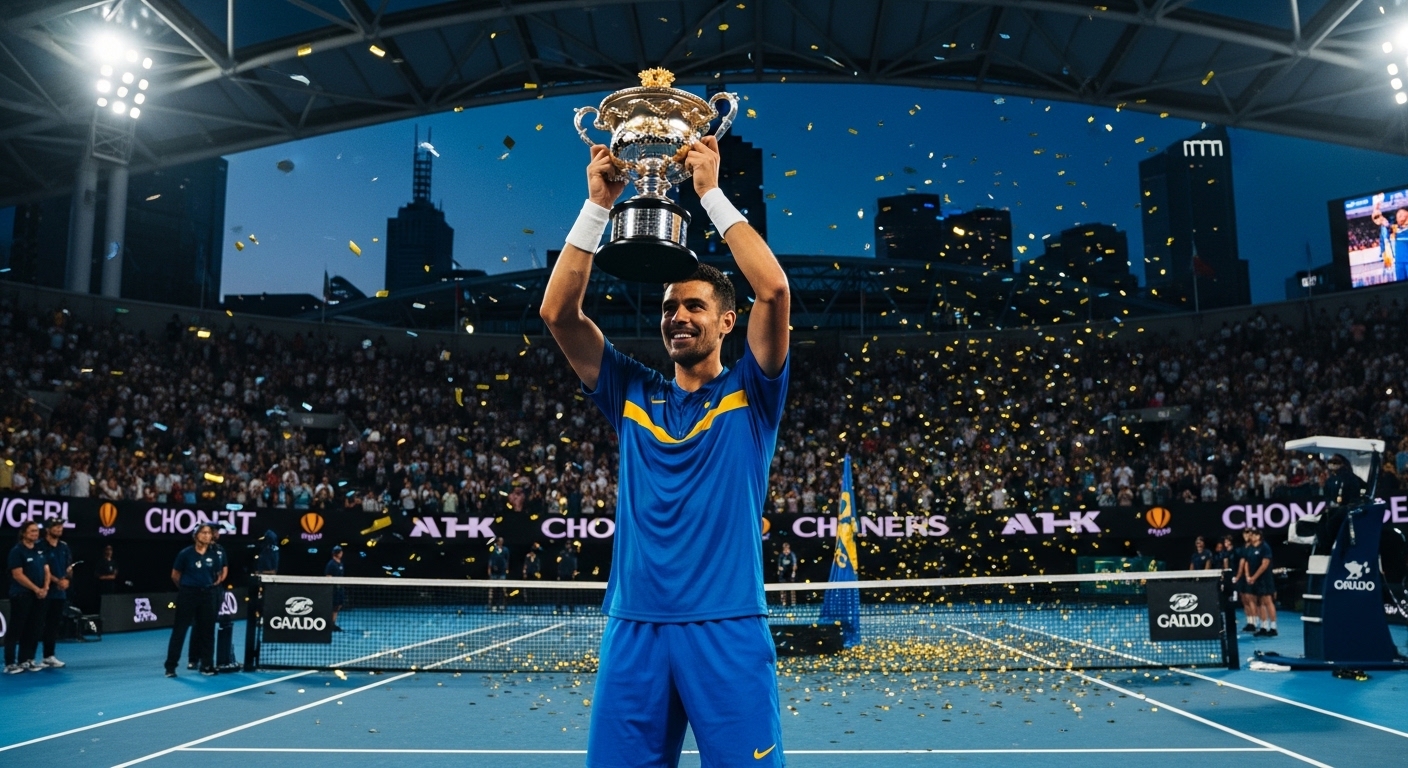
When Novak Djokovic's forehand sailed wide on championship point at Rod Laver Arena on the night of February 1, 2026, Carlos Alcaraz fell to the ground and covered his face with both hands. The match was over. The Australian Open was his. And with it — at 22 years, 8 months and 27 days old — he became the youngest man in tennis history to complete the career Grand Slam.
It is the title that separates the very best from the rest. Not just winning a Slam — winning all four of them. On every surface. In every country. Against every kind of opponent and condition the sport produces. Only nine men had done it in the Open Era before Alcaraz. None were younger than 24 when they completed it. He was 22.
Here is the full breakdown of what happened at Melbourne Park, why the win was different from any of his previous six, and what it means for the sport.
🎾 AO 2026 Men's Final — Key Numbers
What You Need to Know — AO 2026
- Alcaraz is the youngest man ever to complete the career Grand Slam — at 22 years, 8 months and 27 days, breaking Don Budge's record set in 1938
- He ended Djokovic's perfect 10–0 record in Australian Open finals — the Serbian's first ever Melbourne runner-up finish
- Defending champion Jannik Sinner was beaten in the semi-finals by Djokovic, ending his five-consecutive Grand Slam final streak
- Alcaraz's semi-final against Zverev lasted 5 hours 27 minutes — the longest Australian Open semi-final in history
- Elena Rybakina won the women's title, beating World No.1 Aryna Sabalenka 6–4, 4–6, 6–4 for her second major crown
- Venus Williams competed at 45 years old — the oldest woman ever in the Australian Open singles draw
- Total prize money: A$111.5 million — a tournament record
Set by Set: What Actually Happened on the Night
This final was not the dominant display the headline result might suggest. It was a recovery — one of the most decisive mid-match course corrections seen in a Grand Slam final in years. Alcaraz was outplayed completely in the opening set. And then he wasn't.
Why This Win Was Different From the Other Six
Alcaraz has been winning Grand Slams since he was 19. His 2022 US Open felt like a seismic arrival. His Wimbledon titles were dominant. His French Opens were tactical masterclasses. But this Australian Open was categorically different — and not only because of the career Grand Slam milestone.
What made Melbourne 2026 distinct was the specific nature of the challenge it posed. Alcaraz had never won on this surface, in this heat, at the end of this draw. He played a five-hour-twenty-seven-minute semi-final against Zverev — the longest semi-final in Australian Open history — then came back 48 hours later to face the man who had been to ten Australian Open finals and won all ten of them. Djokovic at Melbourne had never lost a final. The circumstances were designed to break someone less experienced and less mentally equipped. Alcaraz dismantled them entirely.
Nobody knows how hard I have been working to get this trophy. I just chased this moment so much. In pre-season it was a little bit of a rollercoaster emotionally.
— Carlos Alcaraz, post-match ceremony, Rod Laver Arena, February 1, 2026The Records That Fell in One Night
✓ Records Broken
- Youngest career Grand Slam in history — men's or women's in Open Era
- Broke Don Budge's 88-year record set at Roland Garros, 1938
- First man to win all 4 Slams before turning 23
- 3–0 in Grand Slam finals vs Djokovic — greatest of all time
- Ended Djokovic's perfect 10–0 Australian Open final record
→ What It Means Long Term
- At 22, already the complete collection — the rest is about numbers only
- No active player matches his Grand Slam spread across all surfaces
- Signals the transition of tennis's defining era is now underway
- Positions him as the sport's central figure for the next decade
- Creates the most compelling active career in tennis right now
Alcaraz vs Djokovic — The Final in Numbers
Women's Final: Rybakina Gets Her AO 2023 Revenge
The 2026 women's final was a rematch of 2023 — and this time the outcome was reversed. Elena Rybakina defeated World No.1 Aryna Sabalenka 6–4, 4–6, 6–4 in two hours and eighteen minutes to claim her second Grand Slam title and first Australian Open crown.
Rybakina became only the fourth woman in history — after Jennifer Capriati, Serena Williams, and Madison Keys — to beat both the world No.1 and No.2 on her way to an Australian Open title. Both finalists had reached the final without dropping a single set — the first time that had happened at any major since Wimbledon 2008. Defending champion Madison Keys lost in the fourth round to Jessica Pegula. Sabalenka, the first woman to reach four consecutive Australian Open finals since Martina Hingis in 2000, left Melbourne without the title once again.
Frequently Asked Questions
Who won the Australian Open 2026?
Carlos Alcaraz won the 2026 Australian Open men's singles, defeating Novak Djokovic 2–6, 6–2, 6–3, 7–5 in the final at Rod Laver Arena on February 1, 2026. Elena Rybakina won the women's title, beating Aryna Sabalenka 6–4, 4–6, 6–4.
Did Alcaraz complete the career Grand Slam at AO 2026?
Yes. By winning the 2026 Australian Open, Carlos Alcaraz completed the career Grand Slam — holding titles at all four majors. He became the youngest man ever to achieve it at 22 years, 8 months and 27 days old, breaking Don Budge's record set in 1938.
How many Grand Slams does Alcaraz have after AO 2026?
After the 2026 Australian Open, Carlos Alcaraz has seven Grand Slam titles: US Open (2022, 2025), Wimbledon (2023, 2024), Roland Garros (2024, 2025), and Australian Open (2026).
What was the AO 2026 women's final result?
Elena Rybakina defeated Aryna Sabalenka 6–4, 4–6, 6–4 in the 2026 Australian Open women's final to win her second Grand Slam. It avenged her loss to Sabalenka in the 2023 Australian Open final on the same court.
What happened to defending champion Jannik Sinner at AO 2026?
Jannik Sinner, the two-time defending Australian Open champion, was eliminated in the semi-finals by Novak Djokovic. His loss ended a remarkable streak of five consecutive Grand Slam final appearances dating back to the 2024 US Open.