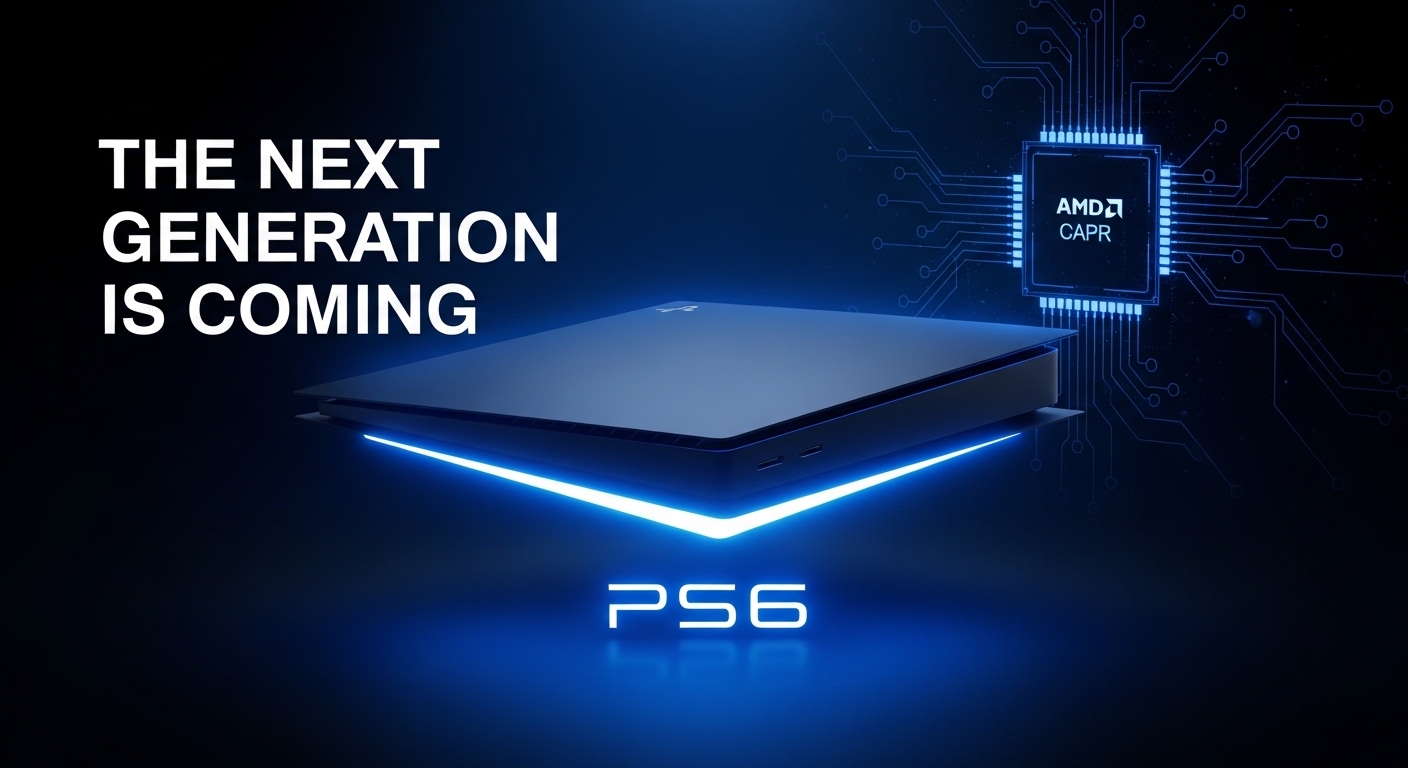
We are now in the sixth year of the PS5 generation. The PS5 Pro launched in late 2024. And yet the conversation in gaming circles has already shifted, decisively and irreversibly, toward what comes next. The reason is simple: the evidence of active PS6 development has become too substantial to ignore. Sony's lead architect has hinted publicly at the technologies going into the next console. AMD has unveiled co-developed systems that are clearly destined for new hardware. Mark Cerny has filed patents. Development kits are circulating. And a growing archive of leaks from sources with demonstrated track records — Moore's Law Is Dead, KeplerL2, Insider Gaming — have painted a picture that is unusually detailed for a console that hasn't been announced.
This article compiles everything that is known about the PlayStation 6 as of March 2026. We distinguish clearly between what is confirmed, what is credibly leaked, and what is speculation — because in a topic this consequential to gaming decisions worth hundreds of dollars, the difference matters.
When Will the PS6 Be Released? The Full Timeline Explained
When will the PlayStation 6 be released?
Sony has maintained a remarkably consistent console cadence: PS3 in 2006, PS4 in 2013, PS5 in November 2020 — all roughly seven years apart. Applying that pattern points to 2027 as the natural PS6 launch year, and that was the widely cited target among the most credible hardware insiders through most of 2025. The AMD agreement to manufacture the rumored "Orion" APU by mid-2027 remains on track, according to Moore's Law Is Dead's January 2026 clarification.
But two significant disruptions have muddied the timeline. First, in January 2026, MST International senior analyst David Gibson warned that rising RAM costs — driven by AI data-centre demand consuming available memory globally — could become a serious problem for Sony in the fiscal year ending March 2027, noting that the PS6 release is "likely to be delayed longer than many expected." Then, in February 2026, Bloomberg published a report from sources familiar with Sony's plans that amplified those concerns significantly. Micron's VP Christopher Moore confirmed at CES 2026 that shortages "could persist for quite some time" and that high memory prices would last "at least until the AI demand starts to fade away."
"If the next PlayStation comes out in 2028, that feels right to me." — Shuhei Yoshida, former President of PlayStation, VentureBeat interview
PS6 Full Specs: Everything Confirmed and Leaked
What are the confirmed PS6 specs?
| Component | PS6 (Leaked/Expected) |
|---|---|
| Codename | Orion Credible Leak |
| System Architect | Mark Cerny Confirmed |
| CPU Architecture | AMD Zen 6 Credible Leak |
| Manufacturing Node | TSMC N2 (2nm) Credible Leak |
| GPU Architecture | AMD RDNA 5 (UDNA) Credible Leak |
| GPU Performance | 34–40 TFlops rasterization (~3× PS5) Credible Leak |
| Ray Tracing | 6–12× improvement vs PS5 via Radiance Cores Project Amethyst |
| AI Upscaling | PSSR 2.0 + Neural Arrays (4K/120fps, 8K/60fps) Project Amethyst |
| Memory | GDDR7, ~24–32GB, ~640 GB/s bandwidth Credible Leak |
| Storage | 2TB SSD (custom, faster than PS5) Expected |
| Display Output | 4K at 120fps / 8K at 60fps Credible Leak |
| HDMI Version | HDMI 2.2 (10K/120Hz capable standard) Expected |
| USB | USB 4 Expected |
| Backward Compatibility | PS4, PS5, potentially PS1–PS3 via Cerny patent Patent Filed |
| Disc Drive | Digital-first; detachable disc drive as accessory Credible Leak |
| Controller | Possible "buttonless" capacitive surface face buttons Patent Filed |
| Design | Slimmer, more compact than PS5 Early Reports |
| VR Support | Backward compatible with PSVR 2 Expected |
🔍 What Is Project Amethyst?
Project Amethyst is a co-development initiative between Sony and AMD that produced three key technologies announced in October 2025: Neural Arrays (GPU compute units grouped to function as a single AI engine for upscaling), Radiance Cores (dedicated hardware for accelerated ray tracing and path tracing), and Universal Compression (bandwidth efficiency technology). Mark Cerny practically confirmed all three will be in the PS6 during AMD's October 2025 presentation.
How Much Will the PS6 Cost?
How much will the PlayStation 6 cost?
⚠️ The RAM Shortage Factor
Micron's VP Christopher Moore confirmed at CES 2026 that AI data-centre demand has created a memory shortage that "could persist for quite some time," with high prices expected to last until at least 2028. The PS6's GDDR7 memory is produced by the same supply chain affected by this shortage. If Sony launches before the shortage eases, consumers will absorb the cost difference at the point of sale. This is the single biggest wildcard in PS6 pricing.
What Games Will Launch With the PS6?
What are the confirmed PS6 launch games?
Project Amethyst: The Technology That Makes PS6 Different From Everything Before It
The most significant technical development in PS6's journey to date isn't a spec number or a teraflop count. It's Project Amethyst — a joint research and development initiative between Sony and AMD that was first announced in late 2024 and received a major update in October 2025 when AMD publicly detailed three technologies that Mark Cerny practically confirmed would be in the next PlayStation console.
The three Project Amethyst technologies represent a fundamental shift in how console hardware approaches the relationship between raw performance and output quality. Rather than simply increasing the number of GPU compute units to push more raw pixels, Project Amethyst uses AI-driven systems to dramatically improve the efficiency of every compute unit that does exist.
Neural Arrays restructure how GPU compute units are grouped, allowing them to function cooperatively as a single AI inference engine. This enables the PSSR upscaling system to work at a level of quality and efficiency that existing hardware cannot achieve — the practical result being that the PS6 can render games at lower internal resolutions and upscale them to 4K or 8K at high frame rates without the visual quality penalties that characterised earlier upscaling implementations.
Radiance Cores are dedicated hardware units for hardware-accelerated ray tracing and path tracing. Multiple leaks indicate the PS6's ray tracing performance will be 6 to 12 times better than the base PS5 — not through raw GPU power alone, but through these dedicated cores handling ray tracing workloads independently from the general compute units. The practical implication for gaming is that titles built for PS6 will be able to implement full path tracing — the same technology that turns screenshots of PC games into photorealistic images — as a real-time feature rather than an offline render setting.
Universal Compression addresses memory bandwidth efficiency, allowing the PS6 to achieve more with the bandwidth it has available. This is particularly relevant given the memory shortage concerns around GDDR7 availability — a console that uses its RAM more efficiently can potentially deliver higher performance even if the raw memory specifications land below ideal.
Project Canis: Sony's First Real Gaming Handheld Since the PS Vita
Is there a PS6 handheld coming?
The significance of Project Canis extends well beyond the hardware specifications. Sony's last true gaming handheld was the PS Vita, which was discontinued in 2019 after struggling against mobile gaming. The PS Portal, released in 2023, is strictly a streaming peripheral — it cannot run games independently. Project Canis represents Sony's acknowledgment that the Nintendo Switch demonstrated a durable market for premium native handheld gaming that the PlayStation ecosystem has been absent from for nearly a decade.
The development detail that speaks most clearly to Canis's imminent reality is the update to PS5 development kits that now prioritises "Low Power Mode" support, with documentation instructing developers to ensure their games can run on only eight CPU threads. Industry analysts widely interpret this as Sony preparing the software ecosystem for handheld hardware — a technical requirement that wouldn't make sense unless handheld-capable PS6 games were already a planning consideration for major studios.
PS6 Backward Compatibility: Will It Play Your Entire Library?
Will the PS6 be backward compatible with PS5?
The January 2026 Cerny patent is the most remarkable single development in the PS6's known history. The PS3's Cell processor was so architecturally unusual — a multi-core hybrid design unlike anything before or since — that Sony deliberately excluded PS3 backward compatibility from both the PS4 and PS5, making it the one gap in PlayStation's backwards compatibility story. The patent describes a system where the PS6's processor dynamically adjusts to replicate older hardware environments, essentially running a hardware-level emulation layer that could handle the Cell architecture's idiosyncrasies. If this works in practice, the PS6 would be the first console to play the entire catalogue of PlayStation's 30-year history.
PS6 vs PS5 vs PS5 Pro — Full Specification Comparison
| Specification | PS5 | PS5 Pro | PS6 (Leaked) |
|---|---|---|---|
| CPU | AMD Zen 2, 8-core | AMD Zen 2, 8-core | AMD Zen 6, 8-core |
| GPU TFlops | 10.28 TFlops | 18.05 TFlops | 34–40 TFlops |
| Manufacturing | 7nm TSMC | 4nm TSMC | 2nm TSMC N2 |
| Memory | 16GB GDDR6 | 16GB GDDR6 | 24–32GB GDDR7 |
| Bandwidth | 448 GB/s | 576 GB/s | ~640+ GB/s |
| Storage | 825GB SSD | 1TB SSD | 2TB SSD |
| 4K Output | Yes (30/60fps native) | Yes (60/120fps PSSR) | 4K/120fps baseline |
| 8K Output | Limited | Limited | 8K/60fps target |
| Ray Tracing | Hardware (limited) | Hardware (enhanced) | Radiance Cores (6–12× PS5) |
| AI Upscaling | None | PSSR | PSSR 2.0 + Neural Arrays |
| HDMI | HDMI 2.1 | HDMI 2.1 | HDMI 2.2 |
| Launch Price (USD) | $499 | $699 | $500–$700 estimated |
PS6 Pre-Order — What We Know Right Now
📦 Pre-Order Status: Not Yet Open
As of March 2026, the PlayStation 6 has not been officially announced by Sony and no pre-orders are open on any retailer. Any website claiming to offer PS6 pre-orders should be treated as unofficial or fraudulent. The PS5 pre-order window opened the day of the price and date announcement (September 2020) and sold out within minutes — expect similar demand for the PS6. Set up PlayStation Direct account alerts and retailer email notifications now to be first in line when pre-orders open.
Based on the PS5's launch playbook, Sony will likely announce the PS6's price and release date at a dedicated PlayStation State of Play event, with pre-orders opening the same day or within 24 hours. The PS5 pre-order debacle — in which units sold out almost immediately in chaotic, under-communicated retailer rollouts — prompted Sony to improve its PlayStation Direct system for the PS5 Pro launch. Expect a more orderly interest-registration and queue-based system for the PS6.
Retailers likely to carry PS6 at launch include PlayStation Direct, Amazon, GameStop, Best Buy, Target, and Walmart in North America; GAME, Argos, Amazon UK, and Currys in the UK; and equivalent major electronics retailers across Europe, Australia, and India. Signing up for stock alerts with each of these now costs nothing and ensures you receive notification the moment pre-orders open.